Anambra’s War of Attrition: Inside the Obi–Soludo Feud Ahead of 2027
Ichie Times Special Feature
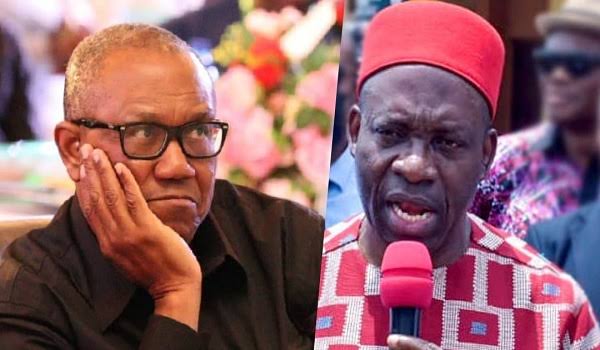
For a state that prides itself on being Nigeria’s commercial and intellectual nerve centre, Anambra has, in recent weeks, found itself consumed by a different kind of enterprise: a running battle over who owes what, to whom, and why it still matters more than a decade after the money was supposedly spent. At the centre of it are two men who have shaped Anambra politics for twenty years and now appear locked in a contest neither seems willing to let go — former Governor Peter Obi and the sitting Governor, Professor Chukwuma Soludo.
The latest round began on the Voice of Ndi Anambra podcast, a platform run by the state government’s New Media unit. Anambra’s Commissioner for Finance, Izuchukwu Okafor, told the moderator that the state was still servicing external loans contracted under previous administrations, including Obi’s. Okafor explained that federal allocation deductions continue automatically under the terms of certain World Bank and similar facilities, and that his government had reduced the state’s overall debt profile by more than 80 percent since 2022 without taking a fresh commercial loan. He framed the disclosure as routine fiscal transparency, not an attack on any predecessor.
Obi did not see it that way. In a video recorded during a visit to Washington, D.C., and later circulated widely on social media, the 2027 presidential hopeful of the Nigeria Democratic Congress rejected any suggestion that he left behind unpaid obligations. He insisted that by the time he handed over in March 2014, he owed no salary, pension, gratuity or contractor payment, and reiterated his long-standing claim of leaving roughly $150 million in savings across three commercial banks for his successor. He went further, challenging the Soludo administration to produce a single verifiable creditor from his tenure or he would end his presidential campaign.
That dare did not go unanswered. On September 16, the Anambra State Government, through Commissioner for Information and Value Reformation, Law Mefor, issued a three-page press statement titled “Gov Peter Obi and Record of Public Debt in Anambra: Facts Beyond Propaganda and Lies.” The document was pointed and, at times, personal. It stated that Obi’s administration spent about $4.05 billion — roughly N5.4 trillion at current exchange rates — over eight years, and separately contracted $123.77 million in external loans across eight World Bank-linked projects covering malaria control, erosion management, education and community development, among others. According to the Debt Management Office figures the statement cited, about $92.35 million of that principal, translating to over N127 billion, remained outstanding as of June 2026.
The statement also disputed Obi’s clean-hands claim on arrears, asserting that his government left verified salary, pension and gratuity debts to retired teachers and workers of the defunct Anambra State Water Corporation, some of which Soludo’s administration says it is still clearing in tranches. It further challenged the substance of Obi’s often-repeated claim of leaving N2.13 billion in an ecological fund account at a First Bank branch in Awka, arguing that the account in question was an internally generated revenue account, not an ecological fund, and that no such balance ever appeared in it. The tone throughout mixed technical rebuttal with open sarcasm, at one point telling the former governor that debt in itself was not damning, but that borrowing to leave schools and hospitals underfunded while claiming a spotless balance sheet did not add up.
Reduced to its essentials, the disagreement is a dispute over figures: how much Obi’s government borrowed, how much has been repaid, and whether any residual obligations belonged to him or to intervening administrations. But anyone familiar with Anambra’s political history knows the argument is never only about naira and kobo. It is the latest instalment in a rivalry that has defined the state’s politics since long before either man held office.
Obi and Soludo’s paths first crossed at the University of Nigeria, Nsukka, where both studied in the same era, though their political collision came much later. Their first direct electoral contest was in 2010, when Soludo, fresh from an five-year stint as Governor of the Central Bank of Nigeria, sought the Peoples Democratic Party ticket to unseat the incumbent Obi. Obi won comfortably, a result that Soludo’s camp long attributed partly to incumbency advantage and partly to what they considered an uneven playing field.
The rivalry hardened in 2013, as Obi neared the end of his second term. Soludo, by then aligned with Obi’s party, the All Progressives Grand Alliance, sought to succeed him as governor but was disqualified from the primary on the grounds that he had not spent long enough in the party to qualify for a waiver. Many observers believe Obi played a decisive role in that outcome, engineering the emergence of Willie Obiano — a retired banker Obi is widely credited with persuading to return from the United States — as APGA’s candidate instead. Obiano went on to win and governed Anambra from 2014 to 2022, keeping Soludo out of Government House for another eight years and cementing a grievance that never fully cooled.
Soludo finally got his turn in 2021, winning the APGA governorship primary and the general election to succeed Obiano, and being sworn in on March 17, 2022 — extending APGA’s unbroken hold on Anambra to nearly two decades. By then, however, Obi had already left the party and Nigeria’s political centre of gravity was shifting in his favour.
Obi’s declaration in 2022 that he would contest the presidency under the Labour Party, announced pointedly from Anambra’s Government House, thrust the old rivalry onto the national stage. Soludo, an APGA governor whose party had no presidential candidate of consequence, might have been expected to stay above the fray. Instead, he published a lengthy public critique of Obi’s presidential bid, arguing that the enthusiasm around Obi’s candidacy — the online movement that came to call itself the “Obidient” movement — rested more on sentiment than on a hard-nosed assessment of governance capacity. The essay was widely read as a proxy for the older feud rather than a dispassionate policy critique, and it drew heavy backlash from Obi’s supporters across the country.
The friction spilled into concrete political skirmishes ahead of the February 2023 elections. Campaign billboards for Obi and his running Labour Party senatorial candidates were pulled down in parts of Anambra, an act attributed to state government functionaries. A tense standoff also played out at a traditional Iguaro festival in Enugw-Ukwu between APGA and PDP senatorial candidates, widely read within the wider Obi-Soludo contest for control of the state’s political direction. Anambra’s House of Assembly campaign that year was also dogged by allegations — which the state government denied — of large-scale vote inducement to blunt the Labour Party’s momentum in legislative races.
Whatever the intent, the strategy produced mixed results. When the presidential votes were counted, Obi swept Anambra decisively, polling well over half a million votes against a combined total of barely fourteen thousand for his two closest rivals — a landslide that underscored how little Soludo’s public opposition had dented Obi’s standing among the state’s electorate. Yet APGA still held its own further down the ballot, winning the majority of Anambra’s State Assembly seats, evidence that Soludo’s structural control of the state machinery remained formidable even as Obi commanded the emotional loyalty of many voters.
For a governor whose academic and technocratic credentials — a former central bank governor with an international reputation in economics — might have suggested a cerebral, above-the-fray leadership style, the recurring skirmishes with Obi have instead put a more combative, thin-skinned side of Soludo’s public personality on display. Critics within Anambra’s commentariat argue that a sitting governor devoting official platforms, including a scripted government podcast and lengthy commissioner-signed press statements, to re-litigating the record of a predecessor who left office over a decade ago suggests insecurity about his own comparative standing with the electorate, particularly given Obi’s enduring popularity nationwide.
Supporters of the governor see it differently. They argue that Soludo has simply been more willing than most Nigerian governors to publicly account for the state’s finances in granular detail, and that his administration’s claim of an 83 percent reduction in debt stock, alongside the clearing of inherited gratuity arrears, is a legitimate governance record deserving of publicity, especially when a highly influential former governor keeps insisting, in increasingly personal terms, that he left the state debt-free. On this reading, the pattern is less about insecurity than about Soludo’s instinct — consistent with his economist’s temperament — to answer every public claim with figures, whatever the political cost of appearing consumed by an old rival.
Either way, the repeated confrontations have shaped how Soludo is perceived beyond Anambra: less as the reformist economist he was introduced to the state as, and increasingly as a politician defined, for better or worse, by his relationship with Peter Obi.
For Obi, the debt controversy carries a different but equally significant risk calculus. As he builds a fresh national platform under the Nigeria Democratic Congress ahead of 2027, his core political asset remains the reputation for frugality and transparent stewardship he built as governor — the story of $150 million left in the treasury, of school infrastructure funded without profligate borrowing, of a leader who, in his own retelling, ran Anambra like a disciplined household. Any credible dent in that narrative threatens the foundation of his broader appeal, which rests less on ideology than on personal credibility.
That is precisely why the Anambra government’s rebuttal was constructed the way it was — leaning on Debt Management Office figures and bank account records rather than mere rhetoric, in an apparent bid to force Obi to litigate specifics rather than repeat generalities. Whether the claims fully withstand scrutiny is a separate question from their political utility: even an inconclusive back-and-forth over loan schedules and account balances can chip away at the aura of unimpeachable fiscal discipline that has powered Obi’s national brand since 2022.
At the same time, the confrontation may also work in Obi’s favour. Each fresh attack from Anambra’s government keeps him prominent in the news cycle at a moment when presidential contests are typically fought for media oxygen, and it allows his supporters to rally around a familiar narrative of an establishment — in this case a rival APGA state government — trying to take down a reformer. Obi’s swift, confident rebuttal, delivered from a stage as prestigious as Washington, D.C., and pitched in the same folksy, plain-speaking register that endeared him to millions of young Nigerians in 2023, suggests his campaign understands the exchange as a test it cannot afford to lose on tone, whatever the ultimate accounting truth turns out to be.
Nearly a decade and a half after Peter Obi left the Anambra Government House, and more than four years into Chukwuma Soludo’s tenure, the two men remain locked in a contest that has outlived the offices that first divided them. What began as a struggle over succession in 2013 has evolved into a proxy war over legacy, credibility and the shape of Nigeria’s opposition politics ahead of 2027. For Anambra residents, the immediate casualty may be a governance conversation reduced to dueling press statements over bank ledgers from a decade ago. For Nigeria’s wider electorate, the more consequential question is which version of the story survives public scrutiny by the time voters go to the polls again — and what that will say about both men’s fitness for the offices, present and aspired to, that they continue to fight so fiercely over.