
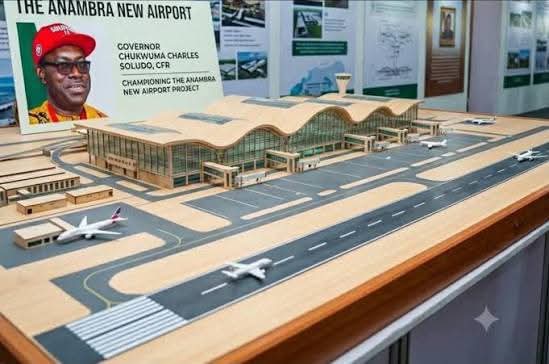
Anambra’s Second Airport: Not Prestige, But Structure
By Dr. Alexander Nwuba
Criticism of Anambra’s proposed second airport often begins from a narrow framing of the state’s aviation debate, one that assumes every new airport project is destined to become another white elephant. That argument, however, becomes less convincing when the historical and structural realities of Anambra’s aviation needs are properly considered.
The state’s first airport was undoubtedly a commendable effort, but its challenges cannot simply be attributed to the current administration. One of the fundamental issues was location. In aviation, location is critical to commercial viability. Airlines are commercially driven, and when an airport’s geography does not adequately align with passenger catchment areas, commercial routes and operational considerations, airlines may naturally favour alternative airports.
The experience of the state’s existing airport demonstrates this challenge. As neighbouring airports with stronger commercial positioning attracted passenger traffic, Anambra’s facility struggled to achieve the level of airline patronage originally anticipated.
This is why the proposed second airport should not necessarily be assessed using the same template.
Anambra is not simply another Nigerian state pursuing prestige infrastructure. It remains one of the country’s major commercial centres and is increasingly seeking to transition from a predominantly trading and consumption based economy towards greater industrial production, manufacturing and exports.
Such a transition requires logistics infrastructure capable of supporting the movement of goods, raw materials and finished products.
A strategically located airport with a strong cargo orientation, therefore, can serve a purpose beyond passenger transportation. If properly planned and integrated with industrial and manufacturing activities, it can become part of a broader logistics network supporting businesses within Anambra and neighbouring states.
The fundamental question should therefore not be whether the airport will initially attract enormous passenger numbers. Rather, it should be whether the infrastructure has been designed around a sustainable economic model capable of generating activity beyond passenger traffic.
Modern airports can derive value from several interconnected activities, including cargo handling, logistics, aviation services, emergency operations, manufacturing support and regional trade.
An airport integrated with industrial and logistics infrastructure can potentially attract manufacturers, exporters, logistics companies and other businesses that depend on reliable movement of goods. Such an ecosystem could create economic activity around the airport while reducing dependence on passenger traffic alone.
Critics are right to draw attention to the numerous underperforming airports across Nigeria. The country has witnessed several aviation projects where infrastructure was developed without sufficient consideration for long term commercial viability, passenger demand, operating costs and the economic ecosystem required to sustain them.
That warning should not be dismissed.
However, the lesson from those projects should be to demand stronger economic planning rather than to reject every new airport project outright.
For Anambra, the experience of the first airport provides an important lesson: aviation infrastructure must be strategically located, commercially relevant and properly integrated with the wider economy.
The proposed second airport should therefore be judged by the strength of its business model, projected cargo and passenger demand, operational costs, connectivity, private sector participation and its ability to generate sustainable economic activity.
If those fundamentals are properly addressed, the airport can become more than an aviation facility. It can serve as a logistics platform supporting Anambra’s industrial ambitions and strengthening its role as a regional commercial hub.
The conversation, therefore, should move beyond symbolism and political optics to structure and economic purpose.
Anambra does not need an airport simply for the prestige associated with having one. What it needs is aviation infrastructure capable of supporting production, trade, logistics and regional economic growth.
The success of the second airport will ultimately depend not on the size of the terminal or the symbolism of its construction, but on whether it becomes a functioning component of the economic network around it.
If properly planned and executed, it could help position Anambra not merely as a major consumption and trading centre, but as a stronger production and export hub.
That is the standard against which the project should be judged.
Dr Alexander Nwuba is the second Vice President, Aviation Safety Roundtable Initiative