OPINION: Why Soludo’s 2027 Budget Estimate For Anambra Is Beyond Numbers
By David Okpokwasili
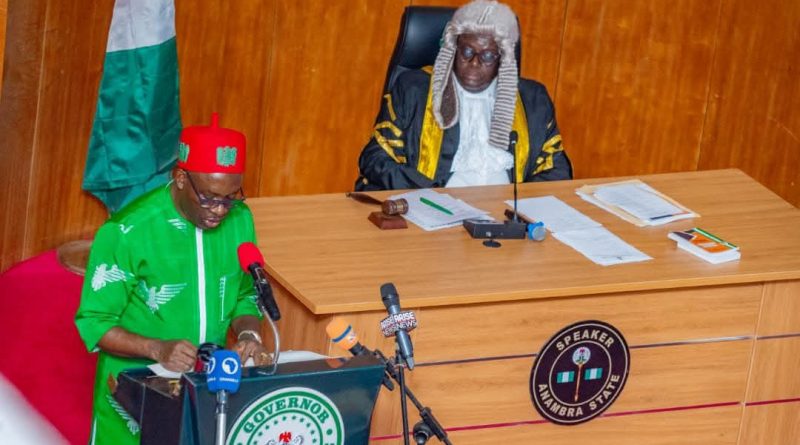
Budgets are usually read as arithmetic: a total, a percentage, a ratio of this to that. On Tuesday, November 24, 2026, Governor Chukwuma Soludo laid before the Anambra State House of Assembly a figure that invites exactly that kind of reading. The 2027 Appropriation Bill is valued at ₦893,435,059,830. It is themed “Solution 2.0: Unlocking New Axis for Sustainable Prosperity.” The number matters, but the theme says more about what the document is for.
Soludo explained that the theme signals his administration’s intention to expand its development vision for the state. The “2.0” is a claim of continuity with an upgrade: the foundations have been laid, and the next phase builds on them. A budget with that framing is a statement about where Anambra is going, not a routine renewal of penultimate year’s spending.
The size of the increase fits that reading. The proposal is 16.58% above the 2026 fiscal estimate and aims to consolidate ongoing reforms while opening new areas of economic growth. In an economy where prices rise faster than most state revenues, a budget that grows without simply restating the old one shows an administration still reaching for more.
The most telling part of any budget is how it divides the money. Capital expenditure is ₦692.66 billion, or 77.53 per cent of the total, while recurrent expenditure is ₦200.78 billion, or 22.47 per cent. More than three-quarters of the plan goes to roads, structures, systems and other long-term assets rather than the daily cost of running government. Many Nigerian states do the opposite. Recurrent obligations such as salaries, overheads and administrative costs consume most of the money, leaving little for development. A budget weighted this heavily toward capital spending reflects a choice to build things that will still serve Anambra people long after the fiscal year ends. Soludo said as much, noting that the 2027 budget keeps a heavy tilt toward capital development, putting over three-quarters of spending into infrastructure and long-term investments.
Numbers become meaningful when they attach to people, and the governor tied his proposal to specific outcomes. He cited the success of the state’s free education policy, which currently benefits nearly 500,000 Anambra children, and plans to recruit 5,000 new teachers to build on the 8,115 initially hired. Behind those figures are half a million children whose families do not have to choose between school fees and other needs. There are also thousands of teachers whose employment shows that policy was turned into payroll. Plans for 5,000 more suggest the administration regards education as an ongoing commitment. That is what a development budget looks like when it is about people as well as projects.
The governor also reviewed progress in security, healthcare delivery and sustainable infrastructure, among other areas. Security is the precondition for everything else: investors, farmers, traders and families plan for the future only when they feel safe. Healthcare and infrastructure complete the picture of a state trying to improve daily life and not merely report growth.
One line from the presentation deserves attention. On fiscal discipline, Soludo said the state has not borrowed from any commercial bank so far. In a country where state debt service often crowds out development spending, this is a notable claim. Whatever one thinks of borrowing in principle, a government that says it is funding its ambitions without commercial loans is telling citizens and potential partners that it takes credibility seriously. That has value beyond the balance sheet, because trust in public finance is hard to build and easy to lose.
A fair assessment must also face the harder numbers. The estimated deficit is about ₦185.56 billion, which is 20.7 per cent of the budget. A gap that size is not trivial, and citizens are entitled to ask how it will be financed and whether the revenue assumptions behind the plan are realistic. This is where the Assembly’s work begins.
It is also where the budget’s meaning gets tested. Ambitious capital plans are easy to announce and harder to execute. The measure of “Solution 2.0” will be completed projects, functioning schools and clinics, and visible results across communities, not the elegance of the document. The Speaker, Somtochukwu Udeze, assured the executive that the House would thoroughly scrutinise the bill so that it directly addresses people’s pressing needs and delivers measurable impact. That is the right standard. The budget remains a proposal pending lawmakers’ consideration and approval. Scrutiny by the legislature, the media and civil society is what turns a proposal into a binding commitment.
Read only as figures, ₦893.4 billion is a large sum to be debated, trimmed and eventually passed. Read as a statement of intent, it shows four things: direction – a government that frames its next phase as an expansion of what has already begun; priorities – a commitment to long-term assets over recurrent costs; people – concrete targets in education and jobs that touch hundreds of thousands of lives and posture – a message of fiscal self-restraint, paired with an honest deficit that invites scrutiny.
For Anambra, the real significance of this budget will emerge over the coming year. If the capital allocation becomes roads that open commerce, classrooms that hold more children, and security that lets enterprise breathe, then the figure will have earned the theme it carries. If it does not, the criticism will be deserved.
For now, the governor has put a clear vision and a measurable plan on the table. The Assembly’s task is to test it, and the people’s task is to hold everyone to it. The budget is beyond numbers because what it buys will be judged in the lives of Ndi Anambra, not in the ledger.
Mr Okpokwasili writes from Awka, Anambra State.